


Property risk is hard to manage when it’s hard to see. Most underwriting teams have plenty of data. What they don’t always have is a clear view of risk across the book.
Likewise, underwriting doesn’t happen at one home at a time. It happens across a book of business where properties are constantly being compared to decide where time should be spent and which policies need closer review.
This is where better risk signals matter. Especially signals that help prioritize which homes are not maintained well and need a closer look to avoid losses.
Home Factors does exactly that. They are property scores that reflect the likelihood of a specific condition or characteristic of the home, in particular the interior.
They help carriers see where risk is higher, where it’s lower, and where additional attention may be needed.
What Home Factors Are
Home Factors are property scores designed to make risk easier to see and compare across a book of business. Each score ranges from 0 to 100 and reflects the likelihood that a specific risk-related condition exists at a property.
Each Home Factor focuses on a single area of exposure. Examples include indicators related to water intrusion and water heater location, electrical panel capacity and issues, foundation type and issues, roof material and remaining lifespan, plumbing materials, window leaks, skylight presence, fire suppression systems, and more. Each score represents a different dimension of property-level risk that is only recently available to carriers.
A higher score indicates stronger evidence that a condition associated with loss potential is present. A lower score is stronger evidence that it is not. The score reflects the strength of the signal based on the data available for that property, not a judgment about the home itself.
Because the scores are standardized, they can be used directly in underwriting workflows, segmentation, analytics, and operational processes. There’s no need to reshape or reinterpret the data. The same signal can be applied consistently across quoting, underwriting, inspection decisions, and portfolio analysis.
How Scores Are Created
Home Factors are built using proprietary and unique property-level data drawn from across the Porch ecosystem and combined with commonly available sources. A sophisticated machine learning algorithm helps analyze this data at scale and apply the same scoring logic consistently across homes. This allows us to generate risk scores for approximately 90% of U.S. homes that hold meaning whether it is used during underwriting, inspection triage, portfolio analysis, or pre-renewal review.
Home Factors are built to perform reliably across portfolios, helping carriers see patterns, compare risks, and support repeatable decision-making at scale.
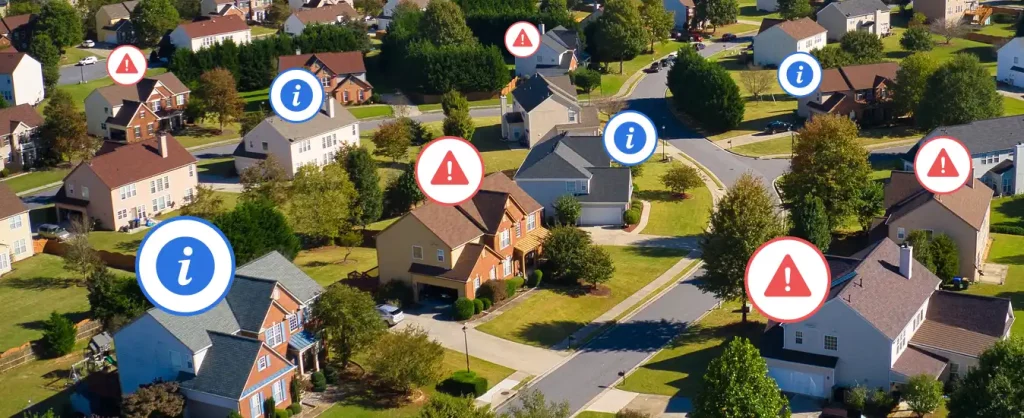
How Carriers Use Home Factors Across the Policy Lifecycle
Home Factors are used at different points in the policy lifecycle, depending on where carriers want clearer visibility and more control.
For example, during pre-fill and quoting, the scores help surface higher-risk properties earlier in the process. As a result, underwriters can focus attention where it is most needed, while lower-risk submissions move through with fewer delays.
Post-bind, Home Factors are often used to guide inspection decisions. Instead of treating every property the same, the scores help determine which homes warrant deeper review and which do not. In practice, this supports more targeted inspections and helps reduce unnecessary cost and friction.
Across the in-force book, Home Factors can also support segmentation and portfolio analysis. Carriers use the scores to identify concentrations of risk, evaluate trends in loss experience, and refine underwriting guidelines.
And at renewal, the scores can highlight changes in risk that may not be visible through traditional data alone. This helps support more informed decisions around pricing, inspection requirements, or non-renewal.
Closing Perspective
Property risk isn’t a single data point, and it rarely shows up in one place. It’s spread across the book, workflows, and time.
When risk is difficult to see or compare, underwriting decisions become harder to manage. Attention can end up in the wrong places, and inconsistencies start to compound as policies move through the lifecycle.
Home Factors provide a clearer way to understand property risk across the book. By translating applying Home Factors, carriers compare homes more easily and focus attention where it matters at scale.
When risk is easier to see, decisions tend to be faster, more consistent, and easier to defend.